Wednesday, February 26, 2014

Update on The “Mercedes Arias” Solidarity and Social Transformation School for the formation of community leaders

This year 2014 the CIS’s Network of Communities are making a very important effort on human development.  We have started The “Mercedes Arias” Solidarity and Social Transformation School for the formation of community leaders.  The goal of this effort is to develop a group of leaders made up of 30 people (20 woman and 10 men) from the Community Network, Water Committees, and the Scholarship Program.  The school is designed so that the workshops are reproduced by the leaders in their local organizations.  It will be a multiplying team. 


The school is set up for seven months from January to July.  The topics are as follows: power, leadership, community organization, environmental contamination, access for woman to comprehensive health care, conflict transformation and solidarity.
All of these topics are prepared with a methodology that allows us to take a step back and examine how we are doing currently.  It is done in a way that each participant reflects on the topic from his/her reality.  We are going to look deeper into our groups in the communities.  Our orientation is that, as leaders, we should be actors and not spectators.  Change should first come from us.


The Methodology

We are working with a facilitator’s guide that is based in popular education.  Some of the material comes from what we worked on last year with an intern and other material is from Equipo Maíz.  We include techniques like role play, energizers, music, etc. We have participation guidelines for the workshops.  The truth it is a space where there is a lot of participation.
The people in charge of the school are some of the grassroots organizers. The participants are given a snack, lunch, and bus fair.  The workshops take place from 9:00am-3:00pm.  At each workshop the participants are give a Facilitator’s Guide so that each of them can put on the workshop in their respective communities.
After the first workshop on power, the leaders reproduced the workshop in five different municipalities.  Some of the comment that emerged was many people saw power as just being something from above that politicians have.  One woman said, “I had never heard people talk about power from below.  The ability that each an every one of us have…now I feel more important.”   On the topic of leadership one youth said “I see myself as a paternalistic leader.  I thought I was doing things the right way, but now I realized I have to change my attitude about my leadership.”  Another man said, “in leadership, honesty is very important.”
As a team we are satisfied with the work.  We think that after the workshops we will see important changes because we see that the participants have the will to change.


La escuela de solidaridad y transformación social para la formación de líderes y lideresas comunitaria/os “Mercedes Arias”

Este año 2014 como red de comunidades del CIS estamos  realizando un esfuerzo muy importante sobre el desarrollo humano; Hemos iniciado la escuela de solidaridad y transformación social para la formación de líderes y lideresas comunitaria/os “Mercedes Arias” este esfuerzo tiene como propósito  la formación de un grupo de 30 personas (20 mujeres y 10 hombres) de la red de comunidades, comités de agua y programa de becas,  para que ellas y ellos  reproduzcan los talleres en sus organizaciones locales, en concreto será un equipo multiplicador

La escuela está programada para 7 meses de Enero a Julio los temas son:
El poder, liderazgo, organización comunitaria, contaminación ambiental, acceso a la salud integral de las mujeres, transformación de conflictos y la solidaridad.

En todos los temas  preparamos  una metodología que nos permita hacer un alto para revisar como estamos en la actualidad, pero además la reflexión la realizamos desde nosotras y nosotros y nos vamos a revisar al interior de nuestros grupos en la comunidades y orientamos que las y los lideres debemos ser actores y no espectadores y que el cambio debe ser primero desde nosotras/os


La metodología

Estamos trabajando con una guía metodológica de educación popular que trabajamos el año pasado con ayuda de un pasante y con algún material que tenemos del equipo maíz, incluimos  mucho las técnicas, los dramas, la exposición las dinámicas, música etc.  Tenemos reglas de convivencia, en realidad es un espacio muy bueno donde hay mucha participación
Las personas encargadas de del desarrollo de la escuela  son algunos de las promotores.   A las y los participantes se les proporciona un refrigerio, almuerzo y viáticos, pues el horario es de 9:00am – 3:00pm  además se les entrega una guía metodológica para la reproducción
Cabe destacar que en 5 municipios ya se reprodujo el tema del poder y algunos comentarios de las personas fueron que ellas relacionaban el poder solo desde arriba o sea desde los funcionarios o políticos etc. “Nunca habían escuchado hablar del poder desde abajo o sea la capacidad que cada una y cada uno poseemos”  “ahora me siento más importante” dijo una mujer y sobre el tema de liderazgo cuando trabajamos  los tipos de liderazgo un joven dijo “yo me ubico en el liderazgo paternalista porque pensaba que yo hacía bien ahora debo cambiar mi actitud respecto a mi liderazgo” otro  señor dijo  “en el liderazgo es muy importante la honestidad”.
Como equipo estamos satisfecha/os  de este trabajo y consideramos que después de los talleres se verán cambios importantes porque  vemos voluntad en las personas que están participando


Wednesday, February 12, 2014

Election Observations in San Luis La Herradura


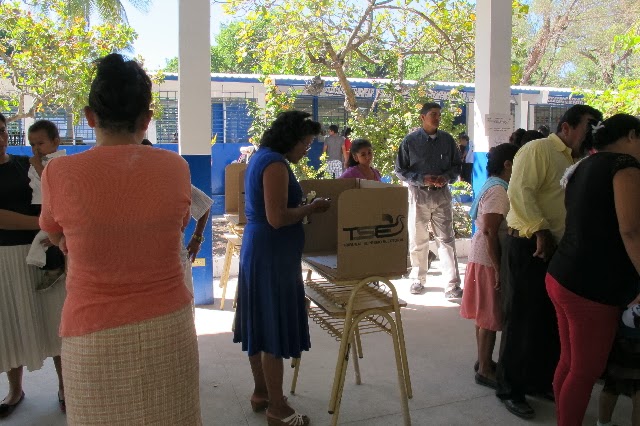
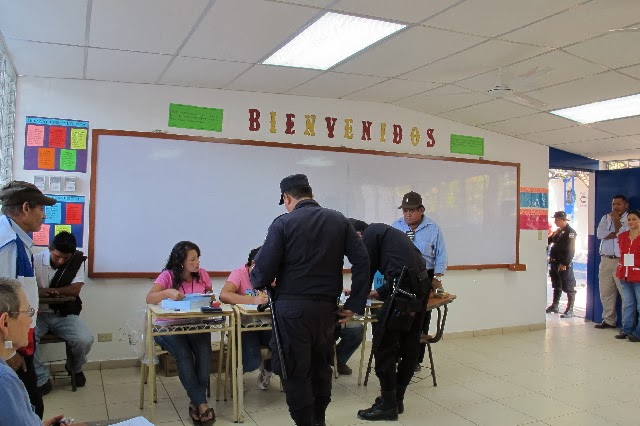
This was my fourth election observer mission since 2009 and for the most part everything ran smoothly, with only a few minor inconsistencies mentioned below.  Even in the relatively short period that I have been observing the elections in El Salvador I have seen significant improvements in the process.  Residential voting, absentee voting, police being allowed to vote, and the electronic transmission of the Acta are all some of those improvements.  Although there are still some problems, I am confidant that they will be resolved and that the process will continue to improve.  The absentee voting had many problems this election, which is understandable since this was the first time it was used.  With these improvements and with the belief that things will continue to improve, I have high hopes for the future elections in El Salvador.   Now that the process has been in place, and the people see how it should work, it is hard to believe that they would ever go back to the way things were with so many checks and balances.

As mentioned, for the most part the elections I observed went very well, but there were a few glitches that I think are worth mentioning.
 *******The CIS is looking for International Observers for the run off election: March 3rd-11th.******
**************Contact us if you are interested: electionmission@cis-elsalvador.org***********

1.  Tinta (ink) – At the table I observed (8157) the President rarely, if ever, checked voters hands for tinta.


2.  Security, at some of the tables, was very poor and could have been easily fixed.  I never saw anyone taking advantage of this, but it could have been a problem.  Photos below illustrate this problem.
Voter could be easily observed

Voter being observed by non family member

An example of good security
Poor security

I could see how this voter voted

Too low and wide opened 
Crowds around voting booths and woman looks into voting booth


Poor security


3.  All the carbon copies of the Acta could not be clearly read.

4.  Ballot boxes placed in wrong locations and close together caused problems.  On three separate occasions I observed voters coming close to depositing their ballot in the wrong box.  Photos below illustrate this problem.


Ballot boxes too close together.  Caused confusion when crowded.


5.  Vigilantes performed tasks beyond their purview.  Photo below illustrate this problem.


Vigilante counts ballots at opening
6.  Laminated DUIs caused considerable discussions at many tables.  How different JRVs resolved this issue was not consistent.  This should be cleared up by TSE. Photos below illustrate this problem.


Discussion over laminated DUI

7.  Observers had the right to photograph completed Acta and then accompany it to the transmission room.  Photos below.

The secretary filling out the final count form-acta. 

Transmission room where the final results are scanned, posted online, and a copy given to each party.

8.  Roles at table not completely clear.  TSE should continue to improve training.


For the first time the Police was able to vote in the center they were stationed at today.


Assisting voters find their JRVs using a smartphone

Thursday, July 25, 2013

2014 Presidential Elections Update

Eugenio Chicas, President of the Supreme Electoral Tribunal in El Salvador recently visited CIS to give us an update on the TSE’s work for next year’s Presidential election. In 2006 El Salvador began the process of moving to a system of residential voting – making polling places much more accessible to all Salvadorans.  And now Chicas and his staff are moving rapidly to complete a system of residential voting everywhere in the country – vastly expanding the polling sites.  This process would be difficult to complete anywhere – finding local sites, notifying every voter of their new polling place, allowing for people to ask for changes, training up sufficient numbers of election workers to staff so many sites and making sure that everyone has proper documents for voting here.  But in El Salvador there are additional challenges. Chicas told us about the struggle to locate voting sites in areas controlled by gangs and the difficulty in securing those sites using the national police or even the army, and making sure that people who live in one gang territory don’t have to vote in another gang territory.   

Despite the challenges of rapidly completing all this work, Chicas said that the challenges posed by the competing political parties and their candidates may be greater.  This year there are already five declared Presidential candidates and he anticipates another announcement soon.  Each of those parties and candidates has the right to have observers in every polling place – and each of them is very interested in the work of the Tribunal – both the system here in El Salvador and new systems being created to accommodate voting by Salvadorans in the diaspora around the world.  In 2014 Salvadoran citizens living outside the county will be able to vote by mail for the first time if they have registered to vote and have a valid DUI.  Chicas also made the note that there is a very low number of people registered because ARENA blocked the emission of the DUI outside the country for two years.  They did not start emitting DUI’s until December of 2012 and people were not able to register to vote until the end of May*.  They have also had problems because the TSE does not have an adequate budget to do publicity. By law, the candidates are not allowed to campaign until 90 days before the election but the parties are already running advertisements, putting up billboards, hosting events, and making public statements.  It promises to be an interesting and wild six months leading up to the February 2nd election and the very likely March 9th run-off.
 
The launch of voting outside the country May 27th 2013
At CIS, we need you.  We need long term volunteers to help organize the mission starting November 2nd or January 2nd.  We also need international observers be a part of the one week long mission January 27th- February 4th and very likely run off mission March 3rd-March 11th.  As an international observer or volunteer you will help to insure that the elections here are fair, without fraud, and democratic.  So, check out the attached information and submit your application.  

More information on Election Observation check out our website or email us: electionmission@cis-elsalvador.org.

Information on volunteering and how to apply (Spanish required and at least three month commitment)


Information on observing and how to apply (No Spanish required, 9 day mission)

*For more information on how to register to vote go to the TSE's website

Thursday, July 11, 2013

Celebrating Sexual Diversity in the Spanish School


 La Escuela de Español acompañó las luchas de la comunidad LGBT.  Primero se visitó a la Organización Entre Amigos.  Joaquín Cáceres explicó a los y las estudiantes la historia de la Asociación y la problemática actual de la comunidad en El Salvador, principalmente los crímenes de odio y la persecución de los y las activistas locales.


The Spanish school accompanied the struggles of the LGBT community.  First they visited the organization “Entre Amigos” (Among friends).  Joaquín Cáceres explained to the students the history of the association and the current issues the community in El Salvador faces, mainly hate crimes and persecution the local activists.


In the classes, we reflected about sexual diversity as a human right.  Each student shared his or her opinion.


En las clases, reflexionamos sobre la diversidad sexual como un derecho humano.  Cada estudiante compartió su opinión.


Además tuvimos una pequeña participación en las actividades programadas por la comunidad LGBT como la Plegaria Rosa.

In addition we had a small participation in the LGBT community's activity the Pink Prayer Ceremony. 


Tuesday, May 7, 2013

A trip to the country

by Buffy Childerhose

As our mini bus climbs higher and higher into the hills surrounding San Salvador, the scenery changes dramatically. Gone are the signs for fast food chains signs and the bedazzled rainbow- busses spewing black smoke. These hallmarks of city life are quickly replaced by things a little less jarring, less loud, less urban. Now? Dusty roads. Pick-up trucks. Chickens.
We’re headed to Zacatales, a pueblo some 35 kilometers outside the country’s capital and the site of two businesses in which CIS has played a role. But neither is a place one can reach via mini-bus. We park at the foot of a small mountain and transfer to a pickup, the only vehicle that can navigate the uneven and challenging dirt roads that will lead us to our first stop.
When we finally alight from the pickup and tumble onto the dusty road, we’re greeted by the smell of something baking. It’s not quite sweet, but it’s not quite savory. It remains a mystery till we cluster around the open door of the building we’ve stopped at and glimpse what’s happening inside.
There, a handful of women, and a few men, gathered around two tables, some pounding and rolling large balls of yellow dough as other tear off strips that they roll into what first look like crescent rolls that are soon stuffed with a milky filling and then pinched around the edges like an empanada.

“They’re sweet, don’t worry,” laughs one of the woman in the cooperative and she wipes her hands on her apron. She is one of the villagers who run the bakery. Today, as a handful of them are busy baking, they share how they went from having almost nothing, to running this busy collective.

“We are grateful to God that we have the opportunity to come here and work everyday,” says another woman as she stands in the bakery’s doorway, the other workers bustling and smiling behind her, transforming piles of flour and other goods into a better future for themselves and their children.
It wasn’t long ago that there was little work in the community, and limited food that was produced locally. “In light of what we needed in the community, we decided to start a women’s group in 2006,” explains Mimita, one of the co-op founders. “Thirty of us organized into a group and a local representative of El Frente (the FMLN) came, and she helped us form a directive for the organization.”
Initially, the women started a cooperative to produce eggs, thanks to a US$ 50,00 from Primoere to build the coops, buy the chickens and create the means to care for them. As that business began to grow, the women’s dreams grew with it.
“Because we already had the eggs,” says Mimita, “we thought we could do more and with the proceeds from selling the eggs we decided to start a bakery, starting small by making bread in my house.” The group enjoyed making bread, and soon they had two flourishing businesses, with half the women working in the bakery and the other half in the chicken farm.

“Out of the egg project, we’ve also figured out a way to have some families have their own chickens. And we’re starting to do the same with cows. We collectively decide who in the community most needs these things, based on size of family and their income,” sys Mimita. The idea is to produce more calves and keep sharing them amongst those with the greatest needs.

The way they make this decision is representative of how the group operates. It’s a participatory co-op with the women making decisions together. So the yield of these projects isn’t just salaries for the women, it’s also a sense of ownership, pride and authority, something that these women had not experienced in the past. And for Mimita and her co-workers, that’s almost as sweet as the pain dulce itself.
(And for the record, the recipe is a secret; all you’ll get when you ask is a smile.)
Not far away from the bakery, another group of women is savoring sweet victories, with nary a grain of sugar in sight. In the rolling hills of Comasagua the women of the Vivaz collective group are collectively blue –in the most positive interpretation of what that phrase might mean.

The Vivaz group is a collective made up of 12 women who decided to form a collective in 2005, an effort born of simple necessity. “There just was no work,” said Delmy, a worker and coordinator with the project. “We needed to do something, so we decided to try to do something for ourselves.”
One of the CIS’s grassroots organizers who worked in the town of Comasagua heard about the group, and brought them to CIS’s attention. “CIS asked if we wanted to learn some useful skills and we said, ‘Of course.’ We were told about Indigo, but we didn’t know what it was then. And through consults with CIS, we decided to undertake a crafts project to make items dyed with indigo. We started the training in indigo dying in 2006. “

Since then, the group has had their struggles, including a large financial loss due to the purchase of a large amount of bad indigo. Eventually, the group built their own relationship with a reputable indigo association, and again began producing high quality work. After these financial losses, the women felt they needed greater control over the process, and that they should actually be producing the clothes they were dyeing. Yet none of them knew how to sew. CIS organized a training program through a local organization and with this training, the women learned how to produce create their own products from start to finish. As they were able to guarantee the quality of the indigo dye, the quality of the articles being dyed, and the design, both the quality of the products and sales increased.
It took some struggle to right themselves after their financial losses, but these women are clearly resolute, spurred on by both necessity and faith. Now, there are now 20 women involved in the collective, and the group produces large amounts shirts, skirts, t-shirts and scarves. Beyond these beautiful items, they’ve also fashioning a better future. “The living conditions of the women and their families have drastically improved since the collective began,” says Delmy.
But this change hasn’t been easy. In Delmy’s community, as well as in the majority of the rural areas in the region, the husbands make the decisions. “So these women depended on their husbands – for money, for choices - even what clothes she might wear,” she explained.

As the women began to earn their own incomes and develop a sense of pride and autonomy, these changes weren’t always well received. “In the beginning it was difficult to deal with - the men weren’t happy,” said Delmy. “ But we’ve learned how to defend our rights,” she said.  “The women began to resist and said,  ‘This is something that I am going to do, that I want to do because it’s going to be of mutual benefit to both of us and our families.’ So in time, the project has helped transform some of the men, and some husbands are even helping with chores to assist the newly busy women.”
Supported by grants and training from CIS and a variety of other NGOs, the collective is now opening up a new building, and the celebration is so large and boisterous that I can barely hear Delmy’s responses to my questions. Which, depending on how you think about it, may be the best response of all.
Legendary English School Volunteer Anne  listening the cooperative
One of the Small Businesses's for Woman: A chicken coop

Volunteers are all smiles


Spanish Student with a group of kids

Preparing the coffee at the Vivaz cooperative


Sharing a meal


Teacher and student-at CIS everybody teaches and everyone learns!


Making pastries is an exact science

Students and volunteers attentively listen to the woman


Showing off the beautiful work of the woman: an indigo scarf


Ready to cut the ribbon


Celebrating


Shaping the delicious pastries 

Enjoying the time in the countryside

The fruits of their labor


Spanish teacher leading the way

un beso

Staff enjoys the outing

Walking through the campo


The Bakery